
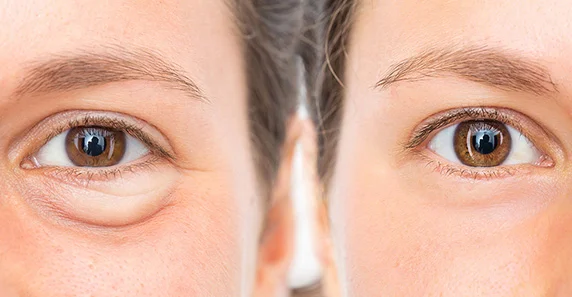
1. Understanding Periorbital Aging
The eyes are the central focal point of human facial expression, communication, and aesthetic appeal. They convey emotion, vitality, and health.
Over time, many individuals notice a distinct shift in their under-eye appearance. What once looked bright, taut, and rested begins to develop persistent puffiness, hollow furrows, shadowy lines, and loose, crepey folds.
. When under-eye bags, severe tear trough hollowing, and lax skin become prominent, surgical intervention via Under-Eye Blepharoplasty emerges as the gold-standard medical solution.
2. The Anatomy of the Lower Eyelid and Why It Changes
To appreciate the precision and transformative power of an under-eye procedure, one must first comprehend the complex, multilayered anatomy of the lower eyelid region.
The Anatomical Layers of the Lower Eyelid
- The Cutaneous Layer (Skin): To begin with, the outermost epidermis and dermis are incredibly thin. Furthermore, this delicate layer contains a minimal subcutaneous fat matrix paired with a high density of dynamic muscle attachments.
- The Muscular Layer (Orbicularis Oculi): Directly beneath this, you will find a specialized sphincter-like muscle that completely encircles the eye. In terms of function, it controls blinking and voluntary squinting while simultaneously providing vital structural tone to the lower lid margin.
- The Orbital Septum: Deeper still, there is a thin, fibrous connective tissue membrane that acts as a structural retaining wall. Principally, its primary biological function is to keep the deeper orbital fat pads safely contained within the bony socket of the eye.
- The Post-Septal Orbital Fat Pads: Consequently, safely tucked behind this septum, the lower eyelid contains three distinct anatomical fat compartments: the medial, central, and lateral fat pads. Ultimately, these localized pockets work together to cushion the globe of the eye within the orbit.
- The Bony Orbital Rim and Midface: Finally, beneath all these soft tissue planes lies the underlying skeletal framework. As a result, this rigid bone structure forms a permanent foundation for the soft tissues of both the lower eye and the upper cheek.
The Mechanism of Periorbital Degradation
As the body undergoes chronological aging and photo-aging, three primary structural failures occur that result in a fatigued, aged appearance:
- Septal Laxity and Fat Herniation: With advancing years, the orbital septum naturally weakens, thins, and loses its tensile strength. Deprived of a strong retaining wall, the three deep orbital fat pads begin to bulge forward, pushing against the lower eyelid skin. This forward protrusion is what creates the physical appearance of chronic, unchanging “under-eye bags.”
- The Tear Trough and Midface Defect: Simultaneously, the facial skeleton undergoes gradual bone resorption, and the deep fat pads of the upper cheek (malar fat) begin to atrophy and descend due to gravity. This creates a severe volume deficit directly below the protruding eye bag. This sunken line is known clinically as the tear trough deformity or palpebromalar groove. The stark contrast between the bulging fat above and the hollow valley below casts a dark shadow, which is frequently misidentified as simple skin pigmentation.
- Dermal Elastosis: Decreased production of Type I collagen and elastin fibers leads to a loss of skin elasticity. The skin becomes redundant, wrinkling like fine crepe paper every time the facial muscles move, eventually forming permanent static wrinkles.
3. Surgical Approaches: Transconjunctival vs. Transcutaneous
There is no singular, cookie-cutter method for performing a successful lower eyelid rejuvenation. The two primary surgical approaches utilized by our expert oculoplastic and cosmetic surgeons are the Transconjunctival Approach and the Transcutaneous (Subciliary) Approach.
1. The Transconjunctival Approach (The Scarless Method)
The transconjunctival technique represents a major evolutionary leap in modern aesthetic facial surgery. It is ideal for individuals who present with prominent under-eye bags caused by fat herniation but still possess excellent skin elasticity with minimal to no redundant, sagging cutaneous tissue.
- The Technique: The surgeon gently everts the lower eyelid to expose the moist internal mucosal lining, known as the conjunctiva. A microscopic incision is made through this internal lining.
- The Fat Manipulation Phase: Once inside, the surgeon does not simply cut away all the fat. Modern aesthetic principles dictate volume preservation.
- The Major Advantages:
- Zero Visible External Scars: Because the healing takes place inside the eyelid, there is absolutely no outward sign of surgical intervention.
- Preservation of Eyelid Shape: By leaving the external skin and orbicularis muscle completely intact, the natural shape, contour, and position of the eye are perfectly preserved, drastically reducing the risk of post-operative eyelid retraction or changes in the eye shape.
- Rapid Recovery: Healing of the internal mucosa is exceptionally fast, requiring no external suture removal.
2. The Transcutaneous (Subciliary) Approach (The Comprehensive Reconstructive Method)
The transcutaneous technique is deployed when a patient exhibits a combination of structural concerns: herniated fat pads plus a significant amount of loose, hanging, wrinkled skin and localized muscle laxity. This presentation is most common in mature individuals experiencing more advanced stages of facial aging.
- The Technique: A highly precise, microscopic incision is made externally, positioned roughly 1 to 2 millimeters directly beneath the lower eyelash line (the subciliary border).
- The Dissection Phase: . The bulging fat is precisely sculpted or relocated to hollow zones.
- The Skin and Muscle Rejuvenation Phase: After addressing the deep volume distribution, the surgeon gently drapes the loose skin upward and outward. .
- The Major Advantages:
- Addresses All Vectors of Aging: Simultaneously corrects deep fat bulges, severe hollows, muscle sagging, and extensive external skin wrinkling.
- Flawless Skin Smoothing: Eliminates heavy skin folds and severe crepey textures that non-surgical options cannot resolve.
4. Step-by-Step Breakdown of the Surgical Procedure
Entering into a surgical journey can feel daunting. At Grazia Skin Clinic, we prioritize absolute patient comfort and psychological reassurance by ensuring you understand every phase of your surgical experience on the day of the procedure.
Phase 1: Pre-Operative Mapping and Artistry
Before any medication is administered, you will meet with your operating surgeon in an upright sitting position. Gravity is a critical factor in lower eyelid aging; when a patient lies flat on an operating table, fat bags recede and hollows shift position. While you are sitting up, the surgeon uses a specialized ultra-fine surgical marker to chart your unique periorbital topography.
Phase 2: Anesthesia and Comfort Management
Lower eyelid blepharoplasty is an outpatient procedure that does not require an overnight hospital stay. To maximize safety and minimize systemic recovery time, it is typically performed under Local Anesthesia with Intravenous Conscious Sedation (frequently referred to as “twilight anesthesia”).
- An anesthesiologist administers a specialized cocktail of intravenous sedatives to put you into a deeply relaxed, dream-like state where you feel completely stress-free and insulated from pain.
- The surgeon then injects a precise local anesthetic fluid containing lidocaine and epinephrine directly into the lower eyelid tissues. The lidocaine blocks all neurological pain signals, while the epinephrine temporarily constricts micro-blood vessels, minimizing intra-operative bleeding and post-operative bruising.
Phase 3: Executing the Incision and Tissue Remodeling
Depending on the chosen path (Transconjunctival or Transcutaneous), the precise incision is made. Using advanced micro-surgical instruments or high-precision radiofrequency surgical tips, the surgeon navigates to the orbital fat compartments.
- If the goal is Fat Reduction, the exact volume of protruding fat is excised.
- If the goal is Fat Repositioning (Fat Transposition), the surgeon releases the structural ligaments holding the tear trough down, creates a pocket over the upper cheekbone, and carefully sweeps the living orbital fat downward into the hollow space, securing it into place with micro-stitches.
Phase 4: Suture Closure and Wound Care
For a transconjunctival approach, the internal mucosal incision is self-healing or closed with fine, dissolvable micro-sutures that require no manual removal. .
5. Comprehensive Clinical Benefts: What to Expect
The decision to undergo lower eyelid surgery yields profound cosmetic and functional rewards. The results achieved through a professionally executed under-eye blepharoplasty provide comprehensive aesthetic rejuvenation that structural creams simply cannot emulate.
1. Permanent Elimination of Under-Eye Bags
Once these fat compartments are sculpted, they do not regenerate, providing a lifelong release from persistent under-eye puffiness.
2. Elimination of Shadows and Fake “Dark Circles”
A vast majority of individuals who complain of severe under-eye dark circles do not actually suffer from hyperpigmentation of the skin. Instead, they are seeing a dark, structural shadow cast by a protruding fat bag over a sunken tear trough.
3. Radical Smoothing of Skin Texture and Wrinkles
For patients undergoing the transcutaneous approach, the physical removal of wrinkled, redundant skin smooths out deep creases and static lines.
4. A Natural, Non-Surgical Look
A primary fear among patients is looking “over-done,” “surprised,” or structurally altered. A skilled surgeon preserves the natural almond or oval aperture of your eyes.
5. Long-Lasting Structural Durability
While dermal fillers inside the tear trough degrade within 6 to 12 months and require constant, costly maintenance, the structural adjustments made during a lower blepharoplasty are built to last. The results routinely endure for 10 to 15 years, and for many patients, the correction of under-eye bags is permanent.
6. Meticulous Aftercare and Timeline for Optimal Healing
The ultimate success of your under-eye rejuvenation depends equally on surgical precision and your dedication to post-operative aftercare. The healing phase requires patience, structural support, and strict adherence to medical directives to maximize scar refinement and prevent complications.
The Immediate 48-Hour Window: Managing Swelling
The first 48 hours following surgery represent the peak phase of inflammatory swelling and bruising. This is a completely normal physiological response to tissue manipulation.
- Cold Compress Protocol: You must apply clean ice packs or cold gel compresses over your eyes for 10 to 15 minutes every single hour while awake. The cold temperature stabilizes cell walls, minimizes fluid exudation, and provides highly effective localized pain relief.
- Head Elevation: You must sleep and rest with your head elevated at a 30 to 45-degree angle using multiple pillows or a reclining chair.
Essential Aftercare Protocols and Restrictions
- Ocular Medication: You will be prescribed specialized antibiotic ophthalmic drops and lubricating ointments.
- Strict Avoidance of Strain: For the first 14 days, you must refrain from heavy lifting, high-intensity cardio, bending over completely at the waist, or any activity that induces facial flushing or strain.
- Zero Eye Rubbing: You must not rub, pull, or exert friction on your lower eyelids under any circumstances. If you experience an itching sensation, use prescribed lubricating drops to soothe the ocular surface.
- Eye Protection and UV Shielding: When stepping outdoors, you must wear dark sunglasses with full UV protection to insulate the healing skin from ultraviolet radiation. Sun exposure on fresh incisions can trigger hyperpigmentation, causing the healing lines to darken.
- Contact Lenses and Makeup Ban: Contact lenses must be avoided for at least 10 to 14 days post-op, as pulling on the lower eyelid to insert lenses can disrupt wound edges.
7. Safety, Risks, and Complication Prevention
Under-eye blepharoplasty is a highly safe, predictable outpatient procedure when performed by a qualified specialist. However, as with any medical intervention involving tissue modification, there are inherent risks that must be fully understood and managed through advanced surgical safeguards.
Potential Risks and Side Effects
- Ecchymosis and Edema (Bruising and Swelling): Temporary side effects that resolve steadily over 2 weeks.
- Chemosis: A temporary swelling or gelatinous puffiness of the clear membrane covering the eyeball (the conjunctiva). It is managed easily with specialized anti-inflammatory eye drops and resolves completely without impacting vision.
- Dry Eye Syndrome: Mild, transient dryness of the ocular surface is common due to temporary changes in blink mechanics caused by swelling. This is proactively managed with preservative-free artificial tears.
- Asymmetry: Slight differences in fat distribution or healing speeds between the left and right eye. Accurate pre-operative marking minimizes this risk.
- Ectropion or Lid Retraction: A condition where the lower lid margin is pulled downward, exposing excessive white sclera. This rare complication occurs if an inexperienced surgeon cuts away too much external skin or fails to account for poor horizontal eyelid laxity.
8. Why Grazia Skin Clinic is Delhi’s Premier Choice for Eyelid Rejuvenatio
. A fraction of a millimeter can make the difference between an average outcome and an extraordinary, life-changing result.
- Unmatched Surgical Expertise: Our specialist surgeons possess advanced training in facial plastic and oculoplastic techniques, ensuring a deep understanding of both periorbital aesthetics and crucial ocular health.
- Artistic Structural Customization: We reject old-fashioned, aggressive surgical approaches that strip away all under-eye fat, which can leave a patient looking gaunt and hollowed out down the road.
- Ultra-Modern Clinical Environment: Grazia Skin Clinic offers a premium experience, combining cutting-edge technology with warm, individualized patient support from your initial consultation through to your final post-operative milestone.
9. Conclusion: Your Journey to Refreshment.
Lower Eyelid Blepharoplasty is an investment in your personal confidence, professional presence, and long-term peace of mind. By gently correcting structural tissue shifts, eliminating tired shadows, and restoring clean, youthful contours, this sophisticated procedure provides an enduring aesthetic renewal.