ADVANCED LASER TATTOO REMOVAL: THE DEFINITIVE CLINICAL GUIDE
Grazia Skin Hair & Laser Clinic (Lajpat Nagar 4, New Delhi)
1. Introduction & The Evolution of Tattoo Removal
Tattoos have served as a form of human self-expression, cultural identification, and personal artistry for millennia. However, the human psyche, personal circumstances, professional trajectories, and aesthetic preferences inevitably evolve. What once felt like a permanent reflection of one’s identity can become an unwanted reminder of the past, an obstacle to professional growth, or simply an aesthetic misfit.
Historically, individuals burdened with “tattoo regret” faced grim prospects. Early methods of removing ink from the dermis were rudimentary, highly invasive, and frequently resulted in severe complications. These primitive techniques included:
- Dermabrasion: Mechanically sanding down the layers of the skin using abrasive wheels or salt blocks.
- Salabrasion: Scrubbing the tattooed area with a coarse salt solution and heat to scrape away the skin layers.
- Surgical Excision: Literally cutting the tattooed tissue out of the body and suturing the surrounding skin back together, an option structurally limited to very small tattoos.
- Acid Injections or Chemical Peels: Applying highly caustic chemicals to burn through the epidermis and dermis, invariably causing horrific, hypertrophic scarring.
These archaic modalities replaced an unwanted tattoo with an even more conspicuous, uneven, and painful scar tissue mass.
The Quantum Leap: Q-Switched and Picosecond Laser Systems
The paradigm shifted dramatically with the advent of Selective Photothermolysis, a groundbreaking medical laser principle pioneered by Dr. Rox Anderson and Dr. John Parrish in the 1980s. This scientific milestone established that specific wavelengths of light could target distinct pigments within the skin without destroying the surrounding healthy tissue.
At Grazia Skin Hair & Laser Clinic, located in the heart of South Delhi at Lajpat Nagar 4, we represent the absolute pinnacle of this technological evolution. Moving far beyond outdated continuous-wave lasers, our clinic utilizes state-of-the-art Q-Switched and Picosecond laser systems.
Unlike older lasers that generated prolonged thermal energy (heat) that essentially baked the skin, modern medical lasers operate on an entirely different scale of time:
- Q-Switched Lasers: Deliver high-intensity energy pulses in nanoseconds (one-billionth of a second).
- Picosecond Lasers: Deliver ultra-short pulses in picoseconds (one-trillionth of a second).
This unimaginable speed creates a rapid acoustic shockwave rather than a thermal burn. The ink particles are shattered mechanically into microscopic, dust-like fragments. Your body’s natural immune system—specifically macro-phages within the lymphatic network—then recognizes these tiny particles as foreign waste and safely carries them away over the course of several weeks.
2. The Science of Ink and Skin Architecture
To understand how laser tattoo removal works at Grazia Skin Clinic, one must first understand the anatomy of human skin and the physics of tattoo placement.
How a Tattoo Becomes Permanent
When a tattoo artist plunges a needle into your skin, it passes directly through the outer, self-renewing layer known as the epidermis. The needle deposits the ink deep into the secondary, structurally stable layer known as the dermis.
[ Epidermis ] -> Constant cellular turnover (sheds every 28 days)
------------------------------------------------------------------
[ Dermis ]    -> Stable collagen network; holds ink permanent
                 (Targeted by Grazia's Advanced Lasers)
The epidermis sheds its cells every 28 days; if ink were placed there, it would vanish within a month. The dermis, however, is a permanent matrix composed of collagen fibers, blood vessels, and immune cells.
When foreign ink particles enter the dermis, the body’s immune system triggers an immediate inflammatory response. White blood cells called macrophages rush to the site to engulf the invading ink molecules and flush them out via the lymphatic system. However, the pigment particles in commercial tattoo inks are far too large and structurally complex for these tiny immune cells to swallow.
Because the macrophages cannot break down or move the heavy metallic compounds and organic dyes, they cap off. The skin cells and surrounding fibroblasts lock the ink particles into place within the dermal matrix. There they sit, suspended permanently—until a specific, high-powered medical laser intervenes.
The Physics of Wavelength Selection
Tattoo inks are not structurally uniform; they are synthesized from a vast array of chemical compounds, heavy metals, and minerals. Consequently, no single laser wavelength can successfully target and eliminate every color in the spectrum. Laser removal relies on matching the color of the tattoo ink with a laser wavelength that the specific color will aggressively absorb.
When an ink particle absorbs the laser light energy, it heats up and expands rapidly, causing a micro-explosive mechanical breakdown. If the wrong wavelength is applied to a specific color, the light will simply bounce off or scatter, resulting in zero ink clearance and a high risk of burning the surrounding skin.
At Grazia Skin Clinic, our advanced multi-wavelength systems allow our dermatologists to carefully customize treatments based on the specific pigments embedded in your skin:
| Wavelength (nm) | Primary Target Colors | Secondary Target Colors | Clinical Utility |
|---|---|---|---|
| 1064 nm (Nd:YAG) | Black, Deep Indigo, Dark Blue | Dark Brown | Safest wavelength for dark skin types (Fitzpatrick IV-VI); deep penetration. |
| 532 nm (Frequency-Doubled Nd:YAG) | Red, Crimson, Bright Orange | Dark Yellow, Flesh Tones | High absorption in melanin; must be used with caution on deeper skin tones. |
| 650 nm / 660 nm (Ruby/Alexandrite or Dye Handpieces) | Green, Lime Green, Teal | Turquoise | Historically difficult colors; requires specialized acoustic targeting. |
| 694 nm / 755 nm (Alexandrite) | Vibrant Blues, Greens | Deep Black | Excellent for resistant sky-blue and forest-green pigments. |
3. Step-by-Step Clinical Procedure at Grazia Skin Clinic
Seeking laser tattoo removal can raise many questions regarding safety, pain, and protocols. At Grazia Skin Hair & Laser Clinic, we minimize anxiety by operating with absolute transparency and strict clinical protocols. Here is exactly what an individual experiences when undergoing treatment at our Lajpat Nagar facility.
[ Phase 1: Clinical Consultation ]
               │
               ▼
[ Phase 2: Sanitization & Numbing ]
               │
               ▼
[ Phase 3: The Laser Treatment ]
               │
               ▼
[ Phase 4: Immediate Post-Care Dressing ]
Phase 1: The Pre-Treatment Clinical Consultation
Your journey begins with a private, thorough evaluation by our senior medical dermatologists. During this diagnostic phase, we build a customized profile of your tattoo based on the internationally recognized Kirby-Desai Scale. This predictive scoring system estimates the total number of sessions required by evaluating six crucial parameters:
- Fitzpatrick Skin Type: Assessing your natural melanin levels (ranging from Skin Type I to VI) to choose the safest energy settings.
- Tattoo Location: Areas with high vascularity and lymphatic flow (like the neck, face, and chest) fade much faster than peripheral areas with slower circulation (like the ankles, fingers, and toes).
- Ink Color: Simple black and dark blue inks require fewer sessions than complex neon yellows, multi-shaded greens, and stubborn reds.
- Amount of Ink (Density): Fine-line script tattoos require significantly less laser energy and fewer passes than dense, solid tribal block work or heavy cover-ups.
- Layering/Cover-ups: If you have an old tattoo that was covered up with a new design, there are multiple layers of dense ink trapped in the dermis, requiring additional sessions.
- Scarring/Tissue Alteration: If the original tattoo artist was heavy-handed and left behind deep dermal scarring, that existing scar tissue traps the ink, requiring special fractional laser steps to break up the scar tissue.
Phase 2: Sanitization and Numbing Protocol
Patient comfort is our top priority. While the sensation of a laser pulse is often described as a snapping rubber band against the skin, we take comprehensive measures to ensure a virtually pain-free experience:
- Area Sterilization: The skin is thoroughly cleansed with medical-grade chlorhexidine or isopropyl alcohol to remove all surface oils, cosmetics, and environmental impurities.
- Topical Numbing Cream: A highly potent, clinical-grade topical anesthetic cream (a customized formulation of Lidocaine and Prilocaine) is applied to the tattoo. The area is wrapped in an occlusive film for 45 to 60 minutes to maximize deep dermal absorption.
- Epidermal Chilling: During the actual laser delivery, we use a specialized cold-air device that constantly blows sub-zero air (≈−20∘C to −30∘C) directly onto the skin. This continuously numbs the nerve endings and protects the epidermis from thermal stress.
Phase 3: The Laser Treatment Experience
Once the skin is fully prepped and desensitized, the dermatologist and the patient put on specialized protective laser goggles designed for the specific wavelengths being deployed.
The doctor positions the laser handpiece over the target area and begins releasing the light pulses. You will hear a rapid clicking or popping sound—this is the acoustic energy interacting with the ink pigment.
As the laser sweeps across the design, a phenomenon known as “frosting” immediately occurs. The rapid release of energy creates tiny gas bubbles within the upper layers of the skin, causing the tattoo to temporarily turn white or chalky. This is a normal sign that the laser has successfully interacted with the dermal ink. The frosting completely subsides within 15 to 30 minutes after the pass is completed.
Phase 4: Immediate Post-Care Dressing
Once the pass is complete, the treated skin is gently cleansed. A layer of soothing, medical-grade antibiotic or restorative barrier ointment is applied to protect the vulnerable skin site. The area is covered with a sterile, non-adherent surgical dressing, which is secured with breathable medical tape to keep environmental pathogens at bay.
4. Comprehensive Benefits of Choosing Grazia Skin Clinic
When deciding where to undergo laser tattoo removal in New Delhi, choosing a specialized medical dermatology clinic over a standard tattoo parlor or a low-cost salon is critical for your safety and results.
Medical Supervision by Board-Certified Dermatologists
At Grazia Skin Clinic, every single laser parameter—from spot size and fluence (energy density) to pulse duration and frequency—is customized by an experienced, board-certified dermatologist.
Tattoo salons often use non-medical staff who lack a deep understanding of skin physiology, increasing the risk of permanent burns, permanent pigment loss (depigmentation), or severe skin infections. Our medical team continuously monitors your skin’s response at every millisecond of the procedure.
Zero Scarring and Minimal Down-Time
Our advanced Q-Switched and Picosecond laser platforms target only the pigment particles within the dermis. Because the pulse durations are incredibly brief, heat does not spill over into the surrounding skin tissue. This eliminates the risk of thermal burns, preventing the formation of keloids or hypertrophic scars. Your skin’s natural texture remains intact, smooth, and healthy throughout the fading process.
Complete Clearing of Stubborn Ink Matrices
Many basic laser centers struggle with stubborn colors like vibrant lime greens, bright sky blues, and deep red pigments, often leaving behind a blurry, muddy smear.
Grazia’s advanced, multi-wavelength lasers break down even these notoriously difficult, complex chemical dyes. Whether you want a tattoo completely erased down to clear skin or simply faded enough for a clean, professional cover-up, we deliver predictable results.
[ Traditional Lasers ] -> Prolonged heat -> High scar risk & incomplete removal
[ Grazia Advanced Lasers ] -> Photo-acoustic shockwave -> Safe skin & clear results
Safety for Darker Skin Tones (Fitzpatrick Types IV–VI)
Treating deeper skin tones requires specialized knowledge and technology. Because Indian skin tones naturally contain more melanin, standard lasers can mistake that natural skin pigment for tattoo ink, resulting in white patches (hypopigmentation) or dark marks (hyperpigmentation).
Our advanced 1064 nm Nd:YAG laser safely passes through surface melanin without disrupting it, targeting only the deeper ink particles. This provides safe, effective tattoo removal for all Indian skin types.
5. Exhaustive Aftercare Protocols and Healing Journey
The actual laser session represents only 50% of the removal process; the remaining 50% depends entirely on post-treatment care and your body’s immune clearance. Proper aftercare protects the skin from infections and accelerates the breakdown of ink.
The Immediate 24 to 48-Hour Recovery Window
- Keep it Covered: Leave the initial sterile dressing applied by our clinical team intact for at least 24 hours. This protects the vulnerable skin barrier from airborne bacteria.
- Keep it Dry: Avoid exposing the treated area to direct water during the first 24 hours. When washing, gently pat the area using a mild, fragrance-free soap and cool water. Never scrub or rub the site with towels or washcloths.
- Manage Thermal Heat: It is normal for the skin to feel warm, swollen, or sunburned. Applying a clean ice pack wrapped in a sterile cloth for 10-15 minutes every hour helps reduce swelling and cools the tissue.
Days 3 to 14: The Critical Cellular Healing Phase
As the skin begins to heal, you may experience redness, swelling, mild bruising, or small blisters. This is a normal part of the body’s inflammatory response as it clears away the shattered ink.
- Handle Blisters Safely: If blisters form, do not pop, pick, or scratch them. Blisters are the body’s natural sterile dressing, protecting the underlying skin as it regenerates. If a blister pops on its own, gently apply an antibacterial ointment and cover it with a fresh, sterile bandage.
- Avoid Crusting and Peeling: As the area dries, a light crust or scab may form. Do not pick at these scabs, as doing so can pull out healing tissue and lead to permanent scarring or infections. Allow them to flake off naturally.
- Moisturize Regularly: Apply a thin layer of an approved healing ointment, pure petroleum jelly, or a soothing barrier cream twice daily to keep the tissue hydrated and speed up cell recovery.
Do Not Scratch / Pick Scabs ──► Prevents Scars & Hyper-pigmentation
Apply Healing Ointment      ──► Keeps Barrier Hydrated
Wear SPF 50+ Sunscreen      ──► Protects New Skin from UV Marks
Long-Term Protection (Between Sessions)
- Strict Sun Protection: The skin becomes highly sensitive to ultraviolet light following laser treatments. Sun exposure can trigger overactive melanin production, leading to dark marks (post-inflammatory hyperpigmentation). Apply a broad-spectrum, mineral-based SPF 50+ sunscreen daily to the treated area, even when indoors or during cloudy days.
- Avoid Submerging in Water: Stay out of public swimming pools, hot tubs, lakes, and saunas until the skin is completely closed and free of scabs. This reduces the risk of contracting waterborne bacterial infections.
- Hydrate and Stay Active: The lymphatic system is responsible for flushing out the shattered ink particles. Drinking plenty of water, exercising regularly, and avoiding smoking all help boost blood circulation and speed up your results.
6. Contraindications, Risks, and Safety Profiles
While laser tattoo removal is highly effective, it is a medical procedure that requires a careful review of your health history to ensure safety.
Absolute and Relative Contraindications
Our dermatologists review these medical factors during your initial consultation:
- Pregnancy and Lactation: We do not perform laser removal during pregnancy or breastfeeding, as the body’s immune system is busy supporting your child and cannot safely process the released ink particles.
- Active Keloidal Tendency: Individuals with a medical history of developing thick, raised keloid scars must be evaluated carefully, requiring gentler energy settings and longer healing intervals.
- Photosensitizing Medications: If you are taking medications that increase sensitivity to light, such as oral isotretinoin for acne, you must stop the medication for at least six months before starting laser treatments.
- Compromised Immune Systems: Conditions such as uncontrolled diabetes, autoimmune disorders, or active undergoing of chemotherapy slow down the body’s healing response, requiring customized care and longer gaps between appointments.
Potential Complications and How Grazia Prevents Them
| Potential Risk | Root Cause | Grazia Prevention Protocol |
|---|---|---|
| Hyperpigmentation (Dark Marks) | Sun exposure or incorrect laser settings on dark skin. | We use the deep-penetrating 1064 nm wavelength and require daily use of broad-spectrum SPF 50+. |
| Hypopigmentation (Light Spots) | Laser energy targets the skin’s natural melanin instead of tattoo ink. | We space out your sessions appropriately and use precise, targeted pulse durations to preserve natural skin cells. |
| Secondary Infection | Scratching scabs or exposing open blisters to bacteria. | We provide sterile medical dressings and detailed, step-by-step antibacterial aftercare instructions. |
| Ghosting Effect | Faint outline of the original design remains in the skin. | We combine advanced treatments with fractional lasers to soften residual texture and blend it seamlessly into your skin. |
7. The Kirby-Desai Scale: Predicting Your Custom Timeline
We believe in setting clear, honest expectations for every patient. To help you understand your treatment plan, we use the Kirby-Desai Scale to estimate the number of sessions your specific tattoo will require.
Total Diagnostic Score =
  Skin Type Score + Location Score + Color Score + Ink Density Score + Scarring Score
1. Fitzpatrick Skin Type Scoring
- Type I (Very fair, always burns): 1 Point
- Type II (Fair skin, easily burns): 2 Points
- Type III (Medium skin, sometimes burns): 3 Points
- Type IV (Olive skin, rarely burns): 4 Points
- Type V (Dark brown skin, rarely burns): 5 Points
- Type VI (Deeply pigmented black skin): 6 Points
2. Anatomical Location Scoring
- Head, Face, or Neck (Excellent circulation): 1 Point
- Upper Torso, Back, or Chest: 2 Points
- Lower Torso, Hips, or Thighs: 3 Points
- Upper Arms or Forearms: 4 Points
- Lower Legs, Calves, or Ankles: 5 Points
- Hands, Feet, Fingers, or Toes (Slower circulation): 6 Points
3. Ink Color Diversity Scoring
- Black Ink Only: 1 Point
- Red Ink Only: 2 Points
- Black and Red Ink Combined: 3 Points
- Blue and Green Inks: 4 Points
- Mixed Colors (Yellows, Oranges, Neons, Purples): 5+ Points
4. Ink Density and Volume Scoring
- Amateur Line Work (Thin, sparse, superficial): 1 Point
- Minimal Script Work (Fine lines, low ink volume): 2 Points
- Moderate Artistic Shading (Standard shading): 3 Points
- Deep, Solid Professional Graphics (Dense tribal or block designs): 4 Points
5. Pre-Existing Scar Tissue Assessment
- No Scarring (Smooth skin texture): 0 Points
- Minimal Scarring (Slight texture from tattoo needle): 1 Point
- Moderate Scarring (Noticeable texture or raised lines): 2 Points
- Severe Scarring/Keloidal Damage from original tattooist: 3 Points
Understanding Your Total Estimated Score
By adding these points together, we get an accurate estimate of the number of sessions required to safely clear your tattoo.
Each session must be spaced 6 to 8 weeks apart. This mandatory gap gives your body’s immune cells enough time to carry away the shattered ink particles and allows the skin barrier to fully regenerate, ensuring your removal process is both safe and effective.
8. Frequently Asked Questions (FAQ)
Q1: Can a tattoo be completely erased down to clear skin?
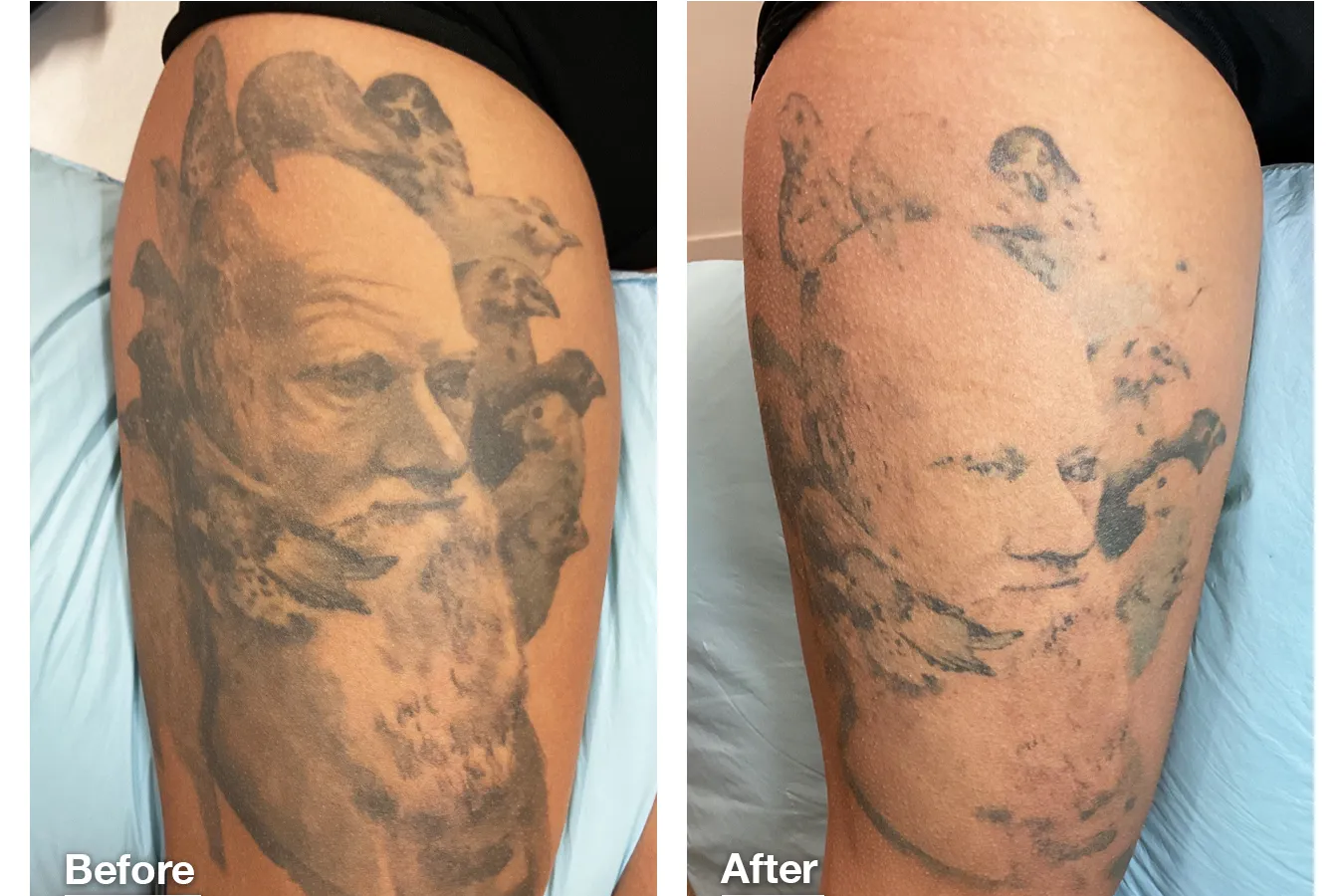
Yes. With our advanced laser technology at Grazia Skin Clinic, most tattoos can be completely removed, leaving no visible trace of the original ink. However, complete removal depends on the type of ink used, the depth of the tattoo, and how well your skin heals. Some complex chemical inks may leave behind a faint “ghost” outline, which we can treat with specialized fractional lasers to restore your natural skin tone.
Q2: Why do I need to wait 6 to 8 weeks between laser sessions?
The laser does not actually destroy the ink; it simply breaks it into tiny pieces. Your body’s immune system has to do the heavy lifting of carrying those pieces away. Spacing out your sessions gives your macrophages time to clear the ink and ensures your skin is completely healed, preventing permanent scarring.
Q3: Are cosmetic tattoos (eyebrows or lip liner) safe to remove with lasers?
Yes, but they require expert medical care. Many cosmetic inks contain iron oxide or titanium dioxide, which can instantly turn black when hit by a laser. Our dermatologists perform a spot test on a tiny, hidden section of the cosmetic tattoo before treating the entire area, ensuring your results are safe and predictable.
Q4: Is laser tattoo removal painful?
Most patients compare the feeling to a rubber band snapping against the skin, along with a warm sensation. To make your treatment as comfortable as possible, we apply a strong, clinical numbing cream before the procedure and use a specialized cooling system that blows sub-zero air onto the skin during the laser treatment.
Q5: Can I get a new tattoo over the same area after it is removed?
Absolutely. If you are planning a cover-up tattoo, you don’t need to completely erase the old design. We can lighten the existing ink in just a few sessions, giving your tattoo artist a clean canvas to work with and more freedom for your new design.
9. Conclusion: Start Fresh at Grazia Skin Clinic
Your skin is a dynamic, living canvas that evolves along with your life, career, and personal style. If you are carrying an old tattoo that no longer reflects who you are, you don’t have to live with it permanently.
[ Old Tattoo Regret ] ──► [ Custom Laser Plan at Grazia ] ──► [ Clear, Restored Skin ]
At Grazia Skin Hair & Laser Clinic, we combine state-of-the-art medical lasers with the expertise of board-certified dermatologists to deliver safe, effective, and predictable tattoo removal. Located in Lajpat Nagar 4, New Delhi, our clinic provides a professional, welcoming environment designed around your skin health and comfort.
Stop letting an old tattoo dictate how you feel about your appearance or limit your professional opportunities. Schedule a personalized consultation with our experts today, and take the first step toward restoring your clear skin.
Grazia Skin Hair & Laser Clinic B-100, Lower Ground, Dayanand Colony, Lajpat Nagar 4, New Delhi, Delhi 110024 Expert Medical Dermatology • Advanced Laser Therapies • Proven Aesthetic Results