Introduction: The Science and Artistry of Hair Restoration
Hair loss (androgenetic alopecia, telogen effluvium, or cicatricial alopecia) affects millions of men and women worldwide, impacting self-image, confidence, and overall quality of life. While temporary solutions such as topical minoxidil or oral finasteride can slow down hair thinning, a permanent, natural-looking restoration of hair density requires advanced surgical intervention.
At Grazia Skin Clinic, hair transplantation is approached as a delicate blend of medical science, microsurgical precision, and artistic hairline design. Modern hair restoration moves far beyond outdated “plug” techniques, utilizing micro-grafting methods that mimic natural hair growth patterns down to individual follicular units.
Understanding Hair Loss Mechanics
Hair loss occurs primarily due to the genetic sensitivity of hair follicles to dihydrotestosterone (DHT), a byproduct of testosterone.
- The DHT Effect: Sensitive hair follicles on the crown and hairline undergo miniaturization—shrinking over cycles until they produce only fine, invisible vellus hairs, and eventually cease growing altogether.
- The Permanent Zone: Follicles located at the back and sides of the scalp (occipital and temporal regions) are genetically resistant to DHT. Hair transplantation strategically redistributes these permanent, healthy follicles to areas of thinning or baldness, ensuring lifelong growth.
Why Choose Medical-Grade Hair Restoration?
Over-the-counter serums, cosmetic camouflage powders, and non-prescribed treatments offer temporary surface cover-ups at best. Modern microsurgical transplantation physically transfers intact, living hair follicles into the dermal layer of the recipient site. Once re-vascularized, these transplanted follicles continue their natural growth cycle indefinitely.
Advanced Hair Transplant Procedures at Grazia Skin Clinic
Grazia Skin Clinic provides state-of-the-art hair restoration procedures tailored to your unique scalp condition, donor density, and aesthetic goals.
1. Follicular Unit Extraction (FUE)
- How It Works: Individual follicular units containing 1 to 4 hairs are harvested directly from the donor area using specialized micro-punches (ranging from 0.7mm to 0.9mm).
- Key Advantages: Leave minimal, virtually undetectable micro-scars, eliminates the need for linear incisions or stitches, and ensures a significantly faster, more comfortable recovery period.
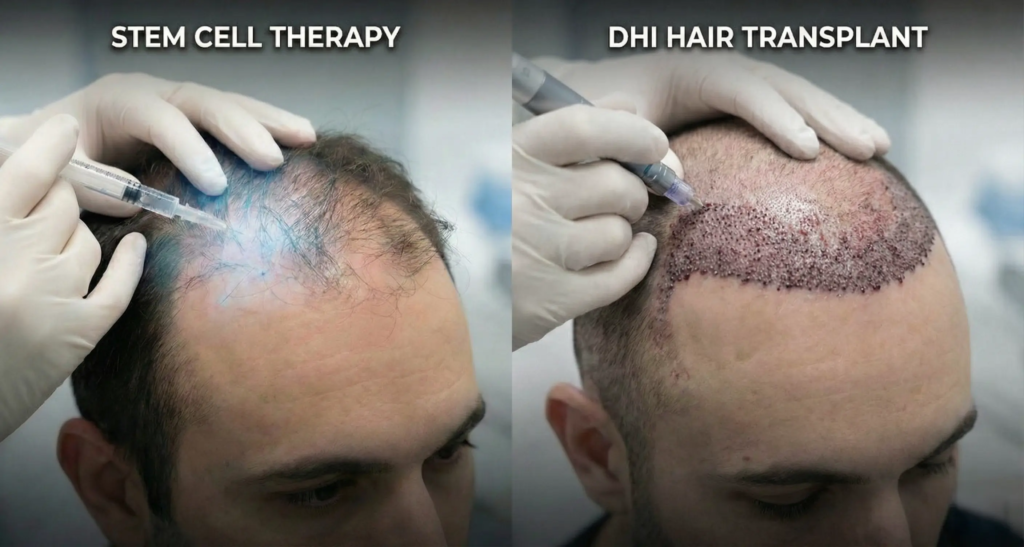
2. Direct Hair Implantation (DHI) / Precision Grafting
- How It Works: Follicular units are extracted and implanted almost simultaneously using specialized, high-precision implanter tools (such as Choi Implanter Pens).
- Key Advantages: Direct implantation allows complete control over the depth, angle, and direction of every single hair, creating an exceptionally natural hairline with maximum follicle survival rates.
3. Platelet-Rich Plasma (PRP) & Growth Factor Therapy Integration
- Adjunctive Therapy: High-concentration PRP or autologous growth factor serums are prepared from the patient’s blood and micro-injected into the scalp before, during, or after the transplant.
- Key Benefits: Accelerates graft acceptance, speeds up healing of micro-incisions, strengthens existing surrounding hair, and stimulates faster transition into the anagen (growth) phase.
Comparison of Primary Techniques
| Feature / Aspect | Follicular Unit Extraction (FUE) | Direct Hair Implantation (DHI) |
| Harvesting Method | Individual micro-punch extraction | Individual micro-punch extraction |
| Implantation Method | Recipient site slits made prior to graft placement | Direct implantation using specialized pen devices |
| Graft Handling Time | Out of body slightly longer | Minimal out-of-body time |
| Scarring | Tiny, scattered dot scars | Virtually invisible dot scars |
| Ideal Candidate | Moderate to extensive hair loss | Receding hairlines, density repair, hairline shaping |
Essential Aftercare & Post-Transplant Recovery Protocol
Post-operative care is just as vital as the surgery itself to guarantee optimal graft survival and healthy hair density.
1: The First 7 Days (Critical Graft Anchoring)
- Graft Protection: Avoid touching, rubbing, or scratching the transplanted area. Sleep with your head elevated at a 45-degree angle using a travel pillow to minimize swelling.
- Gentle Washing: Follow clinic guidelines for soft mist spraying or gentle cup washing using prescribed mild/antiseptic shampoos starting on day 3.
- Avoid Strain: Refrain from strenuous exercise, heavy lifting, bending over, and activities that cause excessive sweating or elevated blood pressure.
2: Weeks 2 to 4 (Scab Clearance & Initial Shedding)
- Scab Removal: Allow small crusts around the grafts to soften and fall off naturally during washing; never force or pick them off.
- Shock Loss Phase: Do not panic if the newly transplanted hair shafts begin to shed around week 3 to 4. This natural phenomenon, known as “shock loss,” is temporary—the hair roots remain secure beneath the scalp.
3: Months 3 to 12 (Growth & Maturity)
- Early Growth (Months 3–4): Fine new hairs begin to emerge from the scalp surface.
- Density Development (Months 6–9): Hair shafts thicken noticeably, covering the treatment zone.
- Final Result (Months 12–14): Full density, natural texture, and final aesthetic results are achieved.
High-Authority Outbound Links for SEO
To boost your website’s search engine credibility and E-E-A-T (Experience, Expertise, Authoritativeness, Trustworthiness), include outbound links to reputable medical resources:
- International Society of Hair Restoration Surgery (ISHRS) — For official patient guides and ethical surgical standards in hair restoration.
- National Center for Biotechnology Information (NCBI / PubMed) — For peer-reviewed medical studies on FUE graft survival rates and PRP efficacy.
- American Academy of Dermatology (AAD) — For clinical insights on managing hair loss causes and post-procedure care.
Why Choose Grazia Skin Clinic for Hair Restoration?
- Expert Microsurgeons: Performed and led by experienced dermatologists and hair restoration specialists.
- Artistic Hairline Design: Customized hairline design crafted according to individual facial symmetry, age, and natural hair growth angles.
- High Graft Survival Rates: Advanced cold-storage graft handling and precision implantation maximize living follicle viability.
- Complete Care Journey: Comprehensive pre-op consultations and detailed post-op tracking ensure long-term, natural results.
Conclusion: Take the First Step Toward Permanent Hair Restoration
Thinning hair does not have to be a permanent condition. With precision techniques like FUE and DHI, Grazia Skin Clinic provides long-lasting, natural hair restoration solutions tailored specifically to you.
Book your comprehensive hair restoration consultation at Grazia Skin Clinic today to reclaim your hair and confidence.