1. Introduction: Understanding Stretch Marks and the Modern Solution
Stretch marks, known medically as striae distensae, represent one of the most common cosmetic skin concerns globally. Whether they appear following a sudden growth spurt during adolescence, manifest during the profound physiological transformations of pregnancy (striae gravidarum), or occur as a result of rapid weight fluctuations or intensive weightlifting, these linear dermal scars can deeply affect an individual’s body image and self-confidence.
Historically, stretch marks were considered an permanent, irreversible alteration of the skin architecture. Conventional wisdom—and an endless market of over-the-counter cosmetic creams, oils, and topical salves—suggested that once the deep layers of the dermis were compromised, very little could be done to restore the skin’s original texture and uniformity. However, contemporary advancements in aesthetic dermatology, micro-invasive clinical technologies, and regenerative medicine have fundamentally transformed this paradigm.
At Grazia Skin Hair & Laser Clinic, located in the heart of Lajpat Nagar, New Delhi, we approach stretch marks not merely as superficial blemishes, but as complex structural dermal injuries. Our philosophy centers on using state-of-the-art, evidence-based interventions to rebuild the skin from within. By pairing advanced energy-based devices, such as fractional laser resurfacing, with biochemical regenerative catalysts like Platelet-Rich Plasma (PRP) therapy, we successfully stimulate deep-level neocollagenesis (the formation of new collagen fibers) and cellular remodeling. This comprehensive, highly comprehensive clinical guide explores the underlying science of stretch marks, outlines the revolutionary treatment modalities available at our clinic, and provides an actionable blueprint for achieving smoother, rejuvenated, and remarkably resilient skin.
2. The Science of the Dermis: How Stretch Marks Form
To appreciate why specialized clinical treatments are necessary to eliminate or significantly fade stretch marks, one must first understand the structural mechanics of human skin. The skin is divided into three primary layers: the superficial epidermis, the structural dermis, and the deep subcutaneous hypodermis.
The Structural Integrity of the Dermis
The dermis acts as the engine room of the skin’s structural integrity. It is composed of a dense extracellular matrix rich in two fundamental proteins:
- Collagen: Provides the structural framework, tensile strength, and support that keeps skin firm.
- Elastin: Grants the skin its elasticity, allowing it to stretch, expand, and snap back into its original position.
When the body undergoes rapid changes in physical volume, the skin is forced to expand at an accelerated rate. While the epidermis can stretch and continually shed and renew its cellular layers, the deeper dermis is bound by its fixed fibrous network.
The Point of Dermal Rupture
When the rate of physical expansion outpaces the elastic capacity of the dermis, the structural network of collagen and elastin experiences micro-failures. The fibers stretch past their yield point and snap. This structural breakdown leads to localized dermal tearing, accompanied by localized inflammation and microscopic bleeding.
As the skin attempts to heal this internal tear, it forms a specialized type of linear scar tissue. Because the structural support beneath the epidermis has been disrupted, the overlying skin thins out, creating the characteristic depressed, textured, or crinkly appearance of a stretch mark.
3. The Evolutionary Phases of Striae: Rubra vs. Alba
Stretch marks undergo a distinct chronological maturation process, changing in color, biochemical composition, and structural density over time. Recognizing which phase your stretch marks are currently in is vital for developing an effective, tailored clinical treatment strategy.
Phase 1: Striae Rubra (The Inflammatory Stage)
Striae Rubra represents the acute, early-stage presentation of stretch marks. When the dermal fibers first tear, the body initiates a classical localized inflammatory response.
- Appearance: These marks appear as red, pink, purple, or deep violaceous linear bands.
- Biochemical Profile: The discoloration is driven by vasodilation (the widening of blood vessels) and hypervascularity as the body attempts to deliver healing factors to the torn tissue. The region may occasionally feel slightly itchy, raised, or tender.
- Clinical Responsiveness: Structurally, Striae Rubra is the ideal phase for intervention. Because the tissue is still highly vascular and actively undergoing an inflammatory repair cycle, it is incredibly receptive to light, heat, and cellular stimulation. Targeted clinical therapies during this phase can halt the scarring process early, yielding fast, dramatic improvements.
Phase 2: Striae Alba (The Chronic Cicatricial Stage)
If left untreated, Striae Rubra gradually matures over several months into Striae Alba, the chronic or old scar stage.
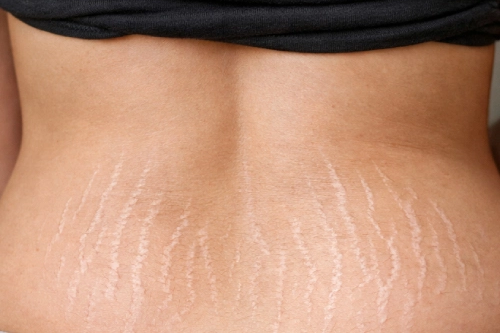
- Appearance: As the acute inflammation subsides and the blood vessels constrict and recede, the marks fade into a pale, pearly white, silvery, or ivory coloration.
- Biochemical Profile: Striae Alba consists of mature, avascular (lacking blood flow), hypocellular scar tissue. The skin over these marks often exhibits a flat or depressed, atrophic texture, feeling noticeably thinner or more crinkled than the surrounding healthy skin.
- Clinical Responsiveness: Because the tissue has stabilized into a permanent scar matrix, Striae Alba is historically difficult to address with superficial creams. Treating mature white stretch marks requires advanced, deep-reaching energy devices and biological growth factors capable of forcing the dormant scar tissue back into an active remodeling phase.
4. The Diverse Triggers: Common Causes of Stretch Marks
Stretch marks are a multifaceted condition driven by a combination of mechanical forces, hormonal shifts, and genetic predispositions. No two individuals develop stretch marks in the exact same manner.
| Trigger Category | Primary Mechanism of Action | Most Common Anatomical Regions Affected |
|---|---|---|
| Pregnancy | Hormonal surges combined with rapid abdominal wall expansion. | Abdomen, breasts, flanks, lower back, upper thighs. |
| Pubertal Growth | Rapid skeletal elongation and soft-tissue expansion during surges. | Outer thighs, hips, buttocks (females); lower back, shoulders (males). |
| Weight Fluctuations | Rapid adipose tissue deposition or loss stretching structural matrix. | Abdomen, upper arms, hips, inner and outer thighs. |
| Rapid Muscle Gain | Accelerated muscle hypertrophy outstripping dermal expansion. | Pectorals, anterior shoulders, biceps, quadricks. |
| Corticosteroids | Inhibition of fibroblast activity leading to collagen degradation. | Widespread distribution; often wider, deeper, and more pronounced. |
The Role of Corticosteroids and Hormonal Shifts
While mechanical stretching is a major driver, the role of hormones—specifically glucocorticoids—cannot be understated. High levels of circulating glucocorticoids, whether from internal surges (such as during puberty or pregnancy) or external medical sources (like prolonged topical or systemic steroid use), inhibit the activity of fibroblasts. Fibroblasts are the specific cells responsible for manufacturing collagen and elastin. When their function is suppressed, the skin’s structural framework weakens, making it highly susceptible to tearing even under minor mechanical stress.
5. Advanced Clinical Modalities at Grazia Skin Clinic
At Grazia Skin Hair & Laser Clinic, we do not believe in a one-size-fits-all approach to scar revision. Stretch marks vary significantly based on depth, age, skin tone, and anatomical location. To achieve optimal clearance, our dermatologists design customized treatment regimens using a sophisticated toolkit of advanced medical technologies.
Fractional CO2 Laser Resurfacing
Fractional CO2 laser therapy stands as the gold standard for treating mature, textured, and deeply set stretch marks (striae alba).
- The Mechanism: This technology works via the principle of fractional photothermolysis. Instead of vaporizing the entire surface of the skin, the CO2 laser delivers microscopic columns of high-energy light down into the dermis, leaving islands of uninjured skin intact between them. These precise micro-injury zones are called Microscopic Treatment Zones (MTZs).
- The Healing Response: The laser heat immediately vaporizes the old, rigid scar tissue within the MTZ, while thermal energy radiates into the surrounding dermis. This controlled thermal stress triggers an immediate contraction of existing collagen fibers and forces fibroblasts into overdrive. Over the subsequent weeks, the surrounding healthy, uninjured tissue accelerates the healing process, replacing the old scar matrix with fresh, tightly organized collagen and elastin fibers. This results in a substantial reduction in the width and depth of the stretch marks, leveling out the skin texture.
Non-Ablative Erbium:YAG and Glass Lasers
For individuals seeking effective structural remodeling with minimal down time, non-ablative fractional lasers offer an exceptional alternative.
- The Mechanism: Unlike the CO2 laser, which vaporizes tissue at the surface level, non-ablative lasers (such as the 1540 nm or 1550 nm wavelengths) bypass the outer epidermis completely. They deposit precise thermal energy deep into the dermal layers while leaving the superficial skin fully intact.
- The Benefits: Because the epidermal barrier remains undamaged, the risk of post-inflammatory hyperpigmentation (PIH) is drastically reduced. This makes non-ablative fractional resurfacing incredibly safe and effective for darker skin tones (Fitzpatrick skin types IV–VI), allowing patients to return to their daily routines almost immediately.
Platelet-Rich Plasma (PRP) Therapy
Regenerative medicine has revolutionized scar therapy, and PRP stands at the absolute forefront of this movement.
- The Sourcing: The process begins by drawing a small sample of the patient’s own blood. This sample is placed into a high-velocity centrifuge, which spins the blood to isolate and concentrate the platelets within the plasma layer.
- The Growth Factor Cocktail: Platelets are natural biological storehouses for powerful cellular signaling molecules, including Transforming Growth Factor-beta (TGF-β), Platelet-Derived Growth Factor (PDGF), and Vascular Endothelial Growth Factor (VEGF). When this highly concentrated PRP matrix is micro-injected or delivered via microneedling channels into the stretch marks, it acts as an accelerated healing catalyst.
- The Synergy: PRP stimulates rapid cell division, recruits new fibroblasts to the damaged areas, and promotes neovascularization (the formation of new blood vessels). By restoring healthy blood flow and essential nutrients to avascular white stretch marks, PRP turns old, stagnant scar tissue into a dynamic environment for healthy skin regeneration.
Advanced Microneedling (Collagen Induction Therapy)
Microneedling is a highly versatile mechanical treatment that leverages the body’s intrinsic healing capabilities to repair dermal tears.
- The Mechanism: Utilizing a medical-grade automated device equipped with ultra-fine, sterile needles, our dermatologists create thousands of precise micro-perforations in the scarred skin.
- The Cascade: These controlled micro-injuries trigger a three-stage healing cascade: inflammation, proliferation, and tissue remodeling. The physical breakdown of old, rigid strands of scar tissue, combined with the subsequent release of endogenous growth factors, leads to the synthesis of organized Type I collagen.
- Transdermal Delivery: Furthermore, these micro-channels serve as open pathways for the transdermal delivery of specialized therapeutic serums, such as high-molecular-weight hyaluronic acid, vitamin matrices, and peptide complexes, maximizing their absorption and efficacy.
Combination Protocols: The Multi-Modality Edge
While individual treatments yield commendable results, the true secret to the exceptional success rates at Grazia Skin Clinic lies in our signature combination protocols. Scar tissue is complex; it requires a multi-dimensional attack.
By strategically combining therapies—such as pairing Fractional CO2 Laser Resurfacing with immediate topical PRP application, or alternating Advanced Microneedling sessions with Non-Ablative Laser treatments—we target the scar from multiple physiological angles simultaneously. The energy device breaks down the structural density of the scar and creates open micro-channels, while the biological growth factors in the PRP accelerate healing and cellular renewal. This synergistic approach drastically compresses total treatment timelines, reduces downtime, and delivers deep, lasting skin remodeling that mono-therapies simply cannot match.
6. The Profound Benefits of Seeking Professional Clinical Care
When faced with stretch marks, many individuals initially turn to retail cosmetic products, spending significant time and resources on over-the-counter creams, body butters, and oils. While these topicals are excellent for hydrating the superficial epidermis, their molecular structures are too large to penetrate the deep dermal-epidermal junction where stretch marks actually reside. True structural transformation requires medical-grade clinical intervention.
Deep Structural Remodeling vs. Surface Hydration
Clinical treatments utilize precise mechanical, thermal, and biological mechanisms designed to penetrate deep into the reticular dermis. Instead of merely masking or smoothing the outer skin texture, clinical modalities actively replace dense scar tissue with healthy, organized extracellular structures. This addresses the structural root cause of the stretch mark, closing the dermal gaps and restoring natural elasticity.
Customization for Safe Treatment Across All Skin Tones
Different skin types react uniquely to thermal energy and injury. For instance, darker skin tones possess highly active melanocytes (pigment-producing cells) and require specialized care to avoid Post-Inflammatory Hyperpigmentation (PIH). At Grazia Skin Clinic, our advanced understanding of laser physics allows us to customize laser pulse durations, energy densities, and cooling intervals. This ensures that every patient—regardless of skin tone—receives a safe, optimized, and highly effective treatment with minimized risks.
Long-Term Textural Refinement and Skin Tightening
The benefits of clinical stretch mark treatments extend far beyond fading discoloration. Energy-based devices like the Fractional CO2 laser generate deep volumetric heating, which triggers immediate tightening of loose, stretched skin matrix. Over a 3-to-6-month period following treatment, as new collagen matures, the skin in the treated area becomes firmer, thicker, and smoother, beautifully blending the stretch marks into the surrounding healthy tissue.
7. Step-by-Step Clinical Journey: What to Expect During Treatment
Embarking on a clinical treatment plan for stretch marks can feel daunting if you don’t know what to expect. At Grazia Skin Clinic, we maintain strict medical protocols to ensure your journey is comfortable, transparent, and completely stress-free from start to finish.
Step 1: Comprehensive Dermatological Consultation
Every successful treatment plan begins with an in-depth clinical evaluation by our expert dermatologists. During this initial phase, we:
- Analyze the age, color, depth, and structural distribution of your stretch marks.
- Evaluate your skin type using the Fitzpatrick Scale to determine the safest laser settings.
- Review your medical history, including lifestyle factors, rapid weight changes, or previous topical treatments.
- Establish a realistic, custom multi-modality treatment schedule tailored to your personal aesthetic goals.
Step 2: Pre-Treatment Preparation
To guarantee a completely comfortable experience, the target area is thoroughly cleansed with medical-grade antiseptic solutions. We then apply a premium, high-potency topical numbing cream (typically an optimized lidocaine/prilocaine matrix) to the skin. .
Step 3: Precise Procedure Execution
Once the area is fully desensitized, the numbing cream is removed, and the skin is prepped for the procedure. Our dermatologist adjusts the medical device to your exact custom specifications. If you are undergoing a Fractional CO2 Laser treatment, the laser handpiece is guided systematically across the stretch marks, delivering precise energy pulses.
Step 4: Immediate Post-Treatment Care
Directly following the procedure, the treated skin will exhibit mild redness (erythema) and a warm sensation similar to a moderate sunburn. We apply a sterile, soothing recovery balm infused with anti-inflammatory compounds and thermal spring water to calm the skin and lock in moisture.
8. Essential Post-Treatment Aftercare and Long-Term Maintenance
The success of any clinical stretch mark treatment depends heavily on how the skin is cared for during the critical post-procedure recovery window. While our advanced devices initiate structural remodeling, your consistent adherence to proper aftercare protocols provides the ideal environment for optimal cellular regeneration.
Managing the Immediate Healing Phase (Days 1–7)
During the initial week after treatment, the skin is in an active recovery state and must be treated with care.
- Keep the Area Hydrated: Apply your prescribed medical emollient or barrier repair cream 3 to 4 times a day. Keeping the skin moist prevents crusting, minimizes itching, and accelerates cellular turnover.
- Gentle Cleansing Only: Wash the treated area gently with lukewarm water and a mild, fragrance-free cleanser. Avoid scrubbing, and gently pat the skin dry with a clean, soft towel.
- Avoid Active Ingredients: Completely pause the use of any skincare products containing retinoids, glycolic acid, salicylic acid, or strong chemical exfoliants until the skin barrier has fully closed and healed.
Sun Protection and Pigment Defense
Newly resurfaced skin is exceptionally vulnerable to ultraviolet (UV) radiation. Exposure to sunlight during the healing phase can cause melanocytes to overproduce pigment, leading to hyperpigmentation.
- Broad-Spectrum Sunscreen: Apply a generous amount of a broad-spectrum, mineral-based sunscreen with an SPF of 50 or higher to the treated area daily, even if you plan to stay indoors.
- Physical Coverage: If the treated area is on the body, wear loose-fitting, breathable clothing that physically shields the skin from direct sunlight. Avoid tanning beds or prolonged outdoor sun exposure for at least 4 to 6 weeks post-treatment.
Supporting Deep Collagen Synthesis
To maximize the production of high-quality collagen from your clinical sessions, it is vital to supply your body with the fundamental building blocks of tissue repair.
- Optimized Nutrition: Maintain a balanced diet rich in Vitamin C (essential for the cross-linking of collagen fibers), Zinc, and high-quality proteins.
- Stay Well-Hydrated: Drink plenty of water daily to support cellular metabolism and maintain optimal skin hydration from the inside out.
9. Conclusion: Reclaim Your Skin Confidence with Grazia Skin Clinic
Stretch marks can serve as reminders of incredible physical journeys—such as motherhood, fitness achievements, or personal growth—but they do not have to dictate how you feel about your body. Advanced aesthetic dermatology has moved far beyond ineffective surface remedies, offering powerful solutions that can truly restore your skin’s smooth texture and appearance.
At Grazia Skin Hair & Laser Clinic in Lajpat Nagar, New Delhi, we blend clinical expertise, state-of-the-art energy-based lasers, and innovative regenerative medicine to deliver transformative results. Our customized multi-modality protocols treat stretch marks at their structural root, helping you achieve smooth, firm, and beautifully uniform skin.
You do not have to hide your skin or settle for temporary fixes. Take the definitive step toward reclaiming your body confidence today. Contact Grazia Skin Clinic to schedule your comprehensive, personalized consultation, and let our expert medical team guide you on a smooth path to clear, radiant skin.
Frequently Asked Questions (FAQs)
1. How many clinical sessions are typically required to see a significant difference?
Because stretch marks involve deep dermal structural changes, achieving optimal results generally requires a structured series of 4 to 6 sessions, spaced approximately 4 to 6 weeks apart. Early-stage red stretch marks (striae rubra) may show notable improvement in fewer sessions, while mature, white marks (striae alba) benefit from an extended combination protocol to achieve deep tissue remodeling.
2. Is the treatment painful, and is there significant downtime?
With the application of our medical-grade topical numbing cream prior to the procedure, discomfort is kept to an absolute minimum. Most patients experience only a warm, tingling sensation during treatment. Downtime varies by modality: non-ablative lasers and microneedling involve minimal downtime (1–2 days of mild redness), while deep fractional CO2 laser resurfacing may result in a sunburned sensation and mild micro-crusting for 4 to 7 days.
3. Can old, white stretch marks be fully removed?
While completely erasing a mature dermal scar down to its original pre-injury state is anatomically difficult, modern combination therapies like Fractional CO2 Laser + PRP can fade old white stretch marks by 60% to 80%. The treatment significantly narrows the marks, improves skin texture, and blends the color seamlessly into the surrounding healthy skin.
4. Are clinical stretch mark treatments safe for all skin tones?
Yes, absolutely. At Grazia Skin Clinic, we use specialized laser settings, proper cooling techniques, and specific wavelengths (such as non-ablative Erbium lasers or customized microneedling protocols) to treat darker skin tones safely. This meticulous control allows us to effectively stimulate collagen while fully protecting the skin from hyperpigmentation.