Rosacea: A Comprehensive Guide to History, Science, and Advanced Care at Grazia Skin Clinic
Rosacea is more than just a “tendency to blush.” For millions worldwide, it is a chronic, often distressing inflammatory skin condition that affects the very center of one’s identity—the face. At Grazia Skin Clinic, we believe that understanding the “why” and “how” of rosacea is the first step toward reclaiming your skin’s health.
This guide provides an exhaustive look into the history of the disease, its biological roots, and the cutting-edge therapeutic protocols we employ to provide lasting relief.
I. The Long History of Rosacea: From “Goutte Rose” to Modern Science
While rosacea is a modern dermatological priority, it has been observed for centuries, often misunderstood as a sign of moral failing or dietary excess.
1. The Medieval Observations
The first medical description of rosacea is attributed to Dr. Guy de Chauliac, a French surgeon in the 14th century. He described “red lesions in the face, particularly on the nose and cheeks,” calling the condition goutterose (French for “pink droplet”) or couperose.
2. The Alcohol Myth
For hundreds of years, rosacea was unfairly nicknamed “pustule de vin” (pimples of wine). It was frequently depicted in art and literature—most notably in Chaucer’s Canterbury Tales and Shakespeare’s Henry V—as a physical manifestation of heavy drinking. We now know that while alcohol can trigger a flare-up, it is not the cause of the disease.
3. Formal Classification
It wasn’t until 1812 that Dr. Thomas Bateman gave it the name “acne rosacea.” However, it took another century for the medical community to realize that rosacea and acne are entirely different biological processes. Treating rosacea with harsh acne medications often makes the condition worse—a mistake we strictly avoid at Grazia Skin Clinic.
II. What is Rosacea? (The Introduction)
Rosacea is a chronic inflammatory dermatosis that primarily affects the “centrofacial” region: the forehead, nose, cheeks, and chin. It is characterized by periods of exacerbation (flares) and remission.
At Grazia Skin Clinic, we view rosacea not just as a cosmetic issue, but as a complex interplay between your immune system, your genetics, and your environment.
III. The Causes: Why Does It Happen?
The exact cause of rosacea remains a subject of intense research, but current science points to a “perfect storm” of factors:
- Innate Immune Dysregulation: Patients with rosacea often have high levels of cathelicidin, a protein that normally protects the skin but, in excess, causes inflammation and blood vessel dilation.
- Neurovascular Pathways: The blood vessels in rosacea patients dilate too easily and stay dilated, leading to persistent redness (erythema).
- Microbiome Imbalance:
- Demodex Mites: These microscopic mites live on everyone’s skin, but people with rosacea often have significantly higher populations, triggering an immune response.
- Bacillus oleronius: A bacterium found in these mites that may further stimulate inflammation.
- Genetics: A family history of “easy flushing” is one of the strongest predictors of developing the condition.
IV. The Four Primary Types of Rosacea
Rosacea is not a “one size fits all” diagnosis. We categorize it into four distinct subtypes:
| Subtype | Name | Key Symptoms |
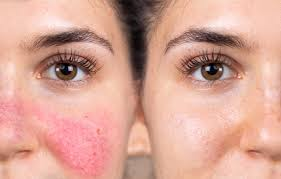
| Type 1 | Erythematotelangiectatic | Persistent redness, visible blood vessels (telangiectasia), stinging/burning. |
| Type 2 | Papulopustular | “Acne-like” rosacea; red bumps and pus-filled pimples. |
| Type 3 | Phymatous | Skin thickening and enlargement, most commonly on the nose (Rhinophyma). |
| Type 4 | Ocular | Red, itchy, or gritty eyes; swollen eyelids; blurred vision. |
V. Advanced Treatments at Grazia Skin Clinic
At Grazia, we move beyond “standard” care to provide a multi-modality approach tailored to your specific subtype.
1. Gold Toning & Vascular Lasers
For Type 1 rosacea, we utilize advanced laser systems that target the hemoglobin in dilated blood vessels. The laser energy collapses these vessels without damaging the surrounding skin, significantly reducing background redness.
2. Intense Pulsed Light (IPL) Therapy
IPL is highly effective for “photo-damaged” rosacea. It uses broad-spectrum light to calm inflammation and even out skin tone.
3. Medical Management
- Topical Anti-inflammatories: Specialized creams (like Ivermectin or Metronidazole) to reduce Demodex populations and soothe the skin barrier.
- Low-Dose Antibiotics: We often use “sub-antimicrobial” doses of doxycycline. This doesn’t kill bacteria but acts as a powerful anti-inflammatory to stop the cycle of redness.
4. Regenerative Procedures
For phymatous (thickened) skin, we offer CO2 laser resurfacing to gently reshape the tissue and restore the natural contour of the nose and face.
VI. Aftercare and Lifestyle Maintenance
Treating it at the clinic is only half the battle. Long-term success requires a “Rosacea-Friendly” lifestyle.
- Trigger Identification: We help you identify your personal “flare factors,” which commonly include spicy foods, red wine, extreme heat, and emotional stress.
- Sun Protection: UV radiation is the #1 trigger for rosacea. We recommend physical (mineral) sunscreens containing Zinc Oxide or Titanium Dioxide, as chemical filters can sometimes irritate sensitive skin.
- The “Less is More” Skincare Rule: Avoid harsh scrubs, alcohol-based toners, and fragrance-heavy products. At Grazia, we provide a curated list of medical-grade cleansers and moisturizers designed to repair your skin barrier.