
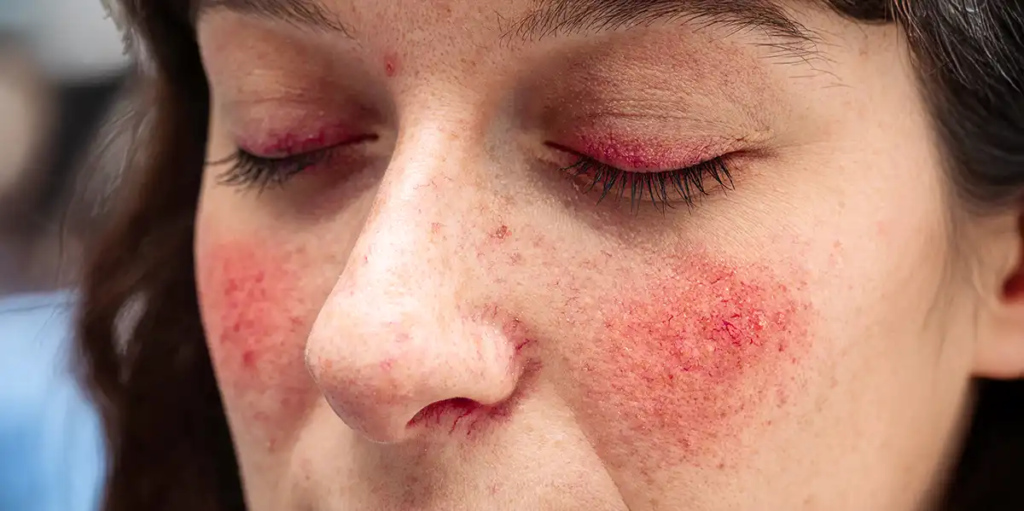
Introduction: The Dynamics of the Facial Vascular Network
Rosacea is a chronic, inflammatory dermatological condition that primarily affects the central face, including the cheeks, nose, chin, and forehead. Often misunderstood as a temporary blush or a simple adult acne flare-up, Rosacea is actually a complex vascular and neurovascular disorder. It involves an overactive immune response, abnormal vascular reactivity, and a compromised epidermal skin barrier.
At Grazia Skin Clinics, we approach Rosacea not merely as a superficial cosmetic issue, but as a deep-seated hyper-reactivity of the facial blood vessels. The condition typically follows a cyclic course, characterized by unpredictable flare-ups triggered by environmental, dietary, and emotional factors. Consequently, without timely clinical intervention, the transient redness can progress to permanent vascular damage, structural tissue changes, and profound skin sensitivity.
Understanding that Rosacea varies significantly from patient to patient, our clinical strategy focuses on dampening the inflammatory cascade, constricting dilated microvessels, and rebuilding the skin’s protective lipid barrier to restore long-term stability.
Symptoms: Reading the Phases of Inflammation
Rosacea manifests through a diverse array of clinical signs that span across sensory discomfort and visible structural changes. Specifically, patients undergoing a flare-up typically present with a combination of the following symptoms:
- Transient Flushing (Erythema): An sudden, intense warmth and redness that spreads across the face. This flushing can be triggered by temperature shifts, spicy food, or stress, and it lasts much longer than a normal blush.
- Persistent Facial Redness: As the condition advances, the blood vessels lose their elasticity and remain permanently dilated. As a result, the central face maintains a continuous pink or deep red hue.
- Telangiectasia: Visible, spider-like networks of broken capillaries winding across the surface of the cheeks and the bridge of the nose.
- Inflammatory Papules and Pustules: Small, solid red bumps or pus-filled blemishes that mimic acne vulgaris. However, unlike true acne, these lesions lack open or closed comedones (blackheads/whiteheads) and feel hot or tender to the touch.
- Burning and Stinging Sensations: The skin barrier becomes hyper-permeable; furthermore, the application of standard skincare products often elicits an immediate, painful burning or stinging sensation.
- Ocular Irritation: A significant number of sufferers experience gritty, bloodshot, or watery eyes, accompanied by frequent styes and swollen eyelids.
- Phymatous Changes: In advanced or poorly managed cases, the skin matrix thickens due to sebaceous gland hyperplasia, leading to a bulbous, irregular texture—most commonly observed on the nose (rhinophyma).
Types of Rosacea: The Four Clinical Phenotypes
To tailor an effective medical protocol, dermatologists classify Rosacea into four primary subtypes based on the predominant clinical presentation.
| Subtype | Clinical Designation | Key Visual Characteristics |
| Subtype 1 | Erythematotelangiectatic Rosacea (ETR) | Persistent flushing, central redness, visible broken capillaries, extreme skin sensitivity. |
| Subtype 2 | Papulopustular Rosacea | Chronic redness accompanied by cycles of painful, acne-like papules and pustules. |
| Subtype 3 | Phymatous Rosacea | Thickening of the skin, prominent skin pores, and irregular nodular swelling (rhinophyma). |
| Subtype 4 | Ocular Rosacea | Watery or bloodshot eyes, burning sensations, light sensitivity, and chronic eyelid inflammation. |
Treatment: The Multi-Pronged Medical Protocol
At Grazia Skin Clinics, our treatment philosophy relies on a combination of topical anti-inflammatories, systemic medications, and advanced laser technologies to tackle the condition from every biological angle.
1. Topical Microvascular Control
To control the local inflammatory response and minimize surface redness, we utilize targeted topical agents:
- Brimonidine & Oxymetazoline: These are selective alpha-adrenergic receptor agonists. Specifically, they work by temporarily constricting the dilated facial blood vessels, reducing visible redness for up to 12 hours.
- Azelaic Acid (15% – 20%): A potent anti-inflammatory agent that clears papules and pustules by scavenging free radicals and suppressing inflammatory cytokines.
- Metronidazole & Ivermectin: These creams target the Demodex skin mites that inhabit human skin pores. Because Demodex mites proliferate rapidly in rosacea-prone skin and trigger severe immune reactions, wiping out their population dramatically lowers baseline irritation.
2. Systemic Anti-Inflammatory Therapy
When topical applications are insufficient to control moderate-to-severe Papulopustular Rosacea, oral medications are introduced:
- Low-Dose Doxycycline (Sub-antimicrobial): At a modified-release dose of $40\text{ mg}$ daily, this medication does not act as an antibiotic; instead, it functions purely as a systemic anti-inflammatory, calming the cellular pathways that trigger acne-like breakouts without disrupting the gut microbiome.
3. Advanced Vascular Laser Therapy (Vascular Targeted)
To address permanent redness and visible telangiectasia, topical medications are ineffective. Therefore, we deploy medical lasers:
- Intense Pulsed Light (IPL) & Pulsed Dye Laser (PDL): These devices emit precise wavelengths of light that are absorbed specifically by the hemoglobin inside your broken capillaries. Consequently, the light energy turns to heat, causing the damaged, over-dilated vessel walls to collapse and seal closed. Over the following weeks, the body naturally reabsorbs the tissue, noticeably clearing the complexion.
Aftercare: Safeguarding the Epidermal Barrier
Because Rosacea skin is fundamentally hyper-reactive, what you do at home is just as critical as the treatments performed within our clinic rooms. A strict, minimalist aftercare regimen is vital to prevent future flare-ups.
- Rigorous Mineral Sun Protection: UV radiation is the number one reported trigger for Rosacea flare-ups, as it accelerates vascular degradation. Therefore, you must apply a broad-spectrum, physical (mineral) sunscreen containing Zinc Oxide or Titanium Dioxide daily. Furthermore, avoid chemical sunscreens, as their active ingredients can heat up the skin and trigger flushing.
- Ultra-Gentle Cleansing: Avoid any form of mechanical friction, such as facial scrubs, loofahs, or cleansing brushes. Instead, wash your face using only your fingertips and a soap-free, non-foaming, pH-balanced cleanser that leaves the natural moisture barrier intact.
- Avoid Known Dietary Vasodilators: Certain foods cause blood vessels to widen reflexively. Specifically, limit your intake of hot beverages, alcohol, and heavily spiced dishes. By doing so, you minimize the internal triggers that set off a thermal flushing cycle.
- Thermal Regulation: Avoid extreme temperature swings. Consequently, you should skip saunas, steam rooms, and hot showers, opting instead for lukewarm water when bathing to keep the facial vascular network calm.
Conclusion: Reclaiming Calm Skin
Rosacea is a complex, life-long skin journey that can take a significant emotional toll on an individual due to its highly visible nature. While there is currently no absolute permanent cure, modern dermatological advancements mean that the symptoms can be exceptionally well managed and controlled. At Grazia Skin Clinics, our dedicated, customized diagnostic approach ensures that your specific rosacea triggers are mapped, your skin barrier is systematically reinforced, and your vascular inflammation is quieted. By pairing cutting-edge laser therapies with defensive home aftercare, you can break free from the cycle of constant blushing and enjoy calm, reliable, and comfortable skin.